
Race, identity and belonging on JET in the 1990s
By Karl English
Spectrum in print
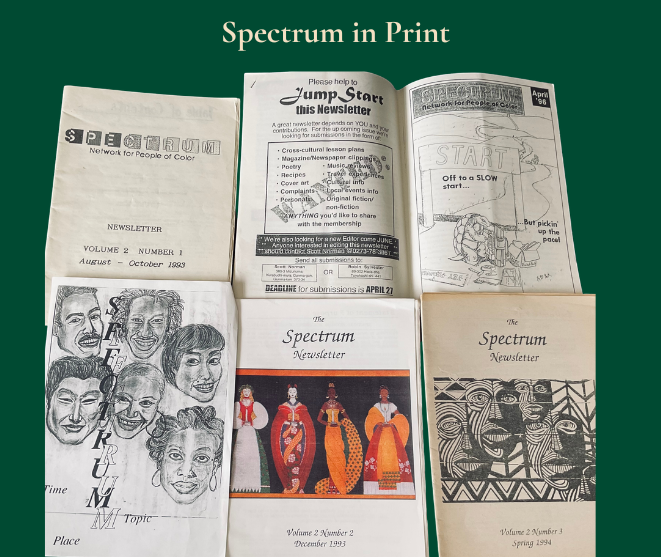
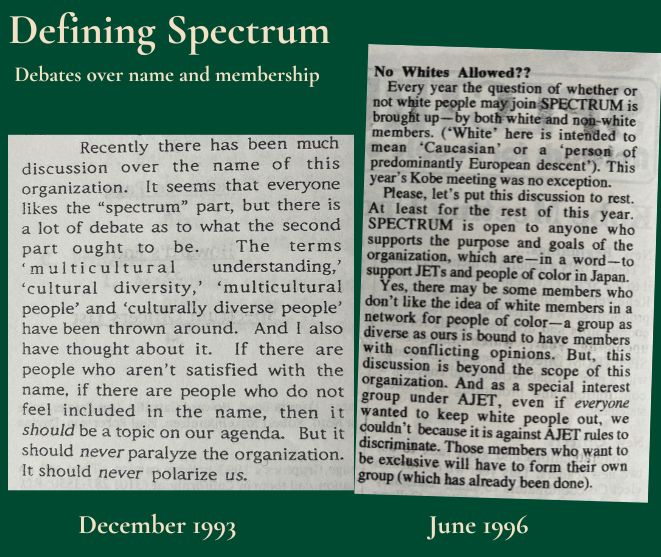
In December 1993, the magazine of Spectrum, the AJET Special Interest Group (SIG) for JET participants of colour, asked a deceptively simple question: should white people be allowed to join? Spectrum had been formed only the previous year, at the JET Programme’s Kobe Renewers Conference in June 1992. I became one of Spectrum’s co-coordinators during its revival in 1996-97. Reading the surviving magazines now has introduced me to parts of its history that I only partly understood at the time.
Although Spectrum saw itself broadly as a group for people of colour, its centre of gravity was distinctly Black, and particularly Black American. The August-October 1993 publication included articles on identity and self-image, doing business as a Black person in Japan, racism and prejudice, and ASRAB, the Association to Stop Racism Against Blacks. Two months later, there were pieces on Black Americans teaching in Japan, race activism, Malcolm X, racism and sexism, and Girl Talk, a group of Black women living in Tokyo.
But Spectrum was never entirely one thing. That same issue included the experiences of a Chinese American JET, poetry, recipes, an ethnic food guide to Tokyo, a planned trip to the Sapporo Snow Festival and a piece from Amnesty International on Burma. And then came the question: should white people be allowed to join Spectrum? What makes the accompanying editorial particularly interesting is that Spectrum’s leadership did not argue for defining the organisation simply by racial identity. Instead, it proposed that Spectrum should be based on “common interests, not common skin pigmentation.”
Four months later, in April 1994, the magazine carried “Reflections on SPECTRUM”, considering the name itself. I cannot know whether the December debate directly prompted that reflection, but reading the issues more than thirty years later, I find the proximity striking. Spectrum appears to have been asking not simply who should be allowed to join, but what the organisation actually was.
That April issue still contained material from the International Association of Black Professionals in International Affairs and a review of Bell Hooks’ Black Looks: Race and Representation. Yet the underlying question remained: What, ultimately, defined membership of Spectrum? Was it primarily a space for Black JETs, for all people of colour, or for anyone who shared its interests and aims? Was belonging determined by ancestry, appearance or self-identification? The impassioned debate around these questions suggests there wasn’t a neat answer then, any more than there necessarily is now.
Then Spectrum went quiet. The next issue in my collection dates from April 1996, and the subject was no longer simply identity and belonging, but survival. A retrospective by the then coordinator described how the organisation had fallen apart after its founders left Japan, amid “personality clashes, power struggles and squabbles”. Another piece was bluntly entitled How Spectrum is Failing.
Spectrum in print
This was one of the vulnerabilities of organisations created by JET participants. We are, by definition, transitory, especially when the maximum term was three years. People arrived, created friendships, networks and publications, accumulated knowledge and experience, and then left Japan. Eventually somebody else had to pick up where they left off. By June 1996, Spectrum was being revived by a rather different group, including JETs who identified as Latine, Black, Māori, or of mixed heritage. I wouldn’t claim that my becoming a coordinator represented some carefully considered evolution in Spectrum’s thinking. The explanation was more prosaic. Spectrum had nearly collapsed and desperately needed people prepared to do the work required to keep it going. An editorial note in June 1996 also recorded that AJET had withheld approximately ¥21,000 in dues during the preceding period of inactivity.
But the earlier magazines make me wonder where I, as someone of mixed heritage, would have fitted into the categories being debated in 1993. They also remind me that cultural exchange on JET was never simply an encounter between Japanese people and foreigners. We were encountering each other. Spectrum’s Statement of Purpose itself recognised that “many JETs of colour may be subject to a unique set of circumstances as issued forth from their host country and other foreigners”.
We arrived carrying assumptions formed in very different countries, communities and families. Nationality, race and ethnicity did not necessarily align. Nor did attitudes towards identity, discrimination and belonging. An African American experience of Japan might differ markedly from that of a Chinese American, and both from those of participants from Britain, Canada, the Caribbean or elsewhere.
There was another peculiarity of JET in the 1990s. For ALTs, it was still overwhelmingly an English-language programme recruiting young people from the English-speaking world. That could create assumptions about what an English-speaking foreigner was supposed to look like. During my time with Spectrum, I remember receiving calls from one or two JETs of colour whose schools had been quite explicit about their disappointment when they arrived. They had expected a stereotypical image of an American. The JET who walked into the school that September did not match it. Nationality somehow acquired a racial appearance. “American” didn’t simply mean someone from the United States; in some people’s imaginations it also described what that person should look like.
Spectrum in print
We weren’t all “foreign” in the same way. And even a group consisting of “people of colour” could never represent a single perspective. Perhaps that is one of the most interesting things the old Spectrum magazines inadvertently document. Participants were not only working out their relationships with Japan. We were also negotiating differences with other international participants whose understanding of race, culture and identity could be very different from our own. When I came across the debate from 1993, the irony seemed obvious. The SIG called itself Spectrum, yet its members were arguing about where the spectrum ended. A spectrum isn’t composed of neatly separated boxes. Its colours bleed into one another, and the precise point at which one becomes another can be difficult to identify. Human identities can be like that too.
Spectrum was trying to create a community around race and identity while its own membership demonstrated how difficult those things could be to define. They debated whether white people could belong. Then its founders left, the organisation faltered, and a new mix of people took it forward. None of this tells me whether those arguing about membership in 1993 were right or wrong. Thirty years later, I find the questions they were asking more interesting than reaching a verdict. Who decides who belongs? Is belonging determined by ancestry, appearance, identity, shared experience, common interests, or some combination of them?
Perhaps the contradiction wasn’t that we called ourselves Spectrum while struggling to define who belonged. Perhaps that struggle was exactly what made the name so appropriate.
Postscript
My surviving copies of Spectrum end in 1997, and I have been unable to establish when the SIG finally ceased operating. Spectrum no longer appears among AJET’s current Special Interest Groups. If any former JETs know what became of it after 1997, why it disappeared, or whether it had any connection with groups that came later, I’d be very interested to hear from you. Perhaps somewhere out there are a few more old magazines, emails or memories that fill in some of the gaps.
A note on terminology
This article discusses race and identity across more than thirty years. Some terms reflect the language of the original Spectrum articles, while others reflect how contributors described themselves or the terminology I use from the vantage point of 2026. Language and preferences around identity have evolved, and I have resisted rewriting the conversations of the 1990s in the language of 2026.
